
The Oberlin History Design Lab provides a space for students to create and communicate historical knowledge in alternative formats beyond traditional approaches such as papers. Across Oberlin History courses, students use digital tools to transform original research into maps, digital exhibits, websites, podcasts, data visualizations, documentary projects, and other forms of public-facing scholarship.
In these projects, students think not only about what historians know, but how we discover, interpret, and communicate the past. Students work with archival documents, historical datasets, maps, images, material objects, and other primary sources while learning to make decisions about research, interpretation, design, and audience. Digital methods provide new ways to identify patterns, visualize change over time and space, reconstruct historical experiences, and make historical research accessible beyond the classroom.
The projects featured here emerged from courses and collaborative research experiences across Oberlin’s History curriculum. They range from investigations of Reconstruction and its continuing legacies, to digital exhibits built from the collections of Oberlin College Archives and Special Collections, to original archival research presented through interactive and multimedia formats.
Together, this work reflects the central mission of the History Design Lab: to give students opportunities to experiment with how history is researched, interpreted, designed, and shared.
Explore Student Projects

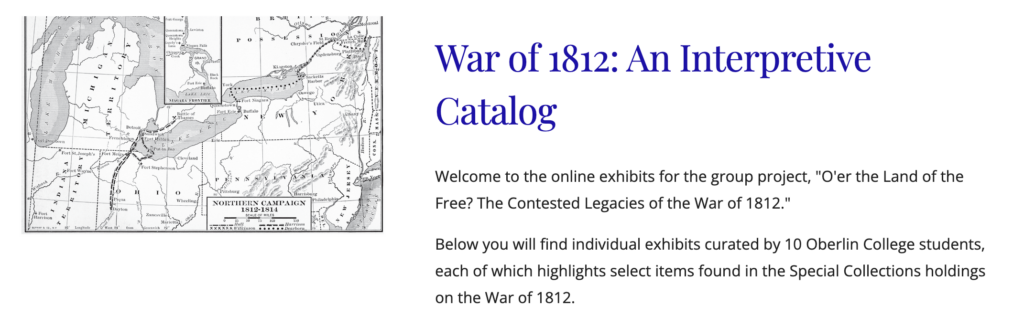
Winter Term 2026: O’er the Land of the Free? The Contested Legacies of the War of 1812
During Winter Term 2026, ten Oberlin students collaborated on O’er the Land of the Free? The Contested Legacies of the War of 1812, a digital exhibition examining the War of 1812 and its consequences through materials held by Oberlin College Special Collections. Working closely with Gena Reynolds in Special Collections, students conducted original research in the Orrin June Collection of War of 1812 items and publications, selecting primary sources around which to develop individual digital exhibits.
Rather than presenting a single narrative of the conflict, the resulting projects explore the war from a range of perspectives and demonstrate how archival sources can complicate familiar accounts of its causes, experiences, and legacies. Students curated primary sources, analyzed their historical contexts and limitations, and translated their archival research into public-facing digital scholarship. Together, the ten exhibits form an interpretive catalog that showcases both the richness of Oberlin’s Special Collections and the possibilities of collaborative digital history.
HIST 399: Narrating the Archives – Local Voices & Global Collections
Students investigated archives as both sites of research and objects of historical inquiry. After working with physical and digital collections from Oberlin and around the world, students developed original archival research projects presented through formats including digital exhibits and mapping.
HIST 388/264: History Design Lab Practicum for Women at War
In Spring 2026, students Nuala Sharon and Katherine Cszizar each created a podcast series exploring the diverse experiences of women in warfare across different historical periods and geographic regions. Drawing on original research and primary and secondary sources, each episode examines a particular dimension of the relationship between women, gender, war, and military institutions.
The podcast episodes highlight the many ways women have experienced and shaped warfare—as soldiers, civilians, nurses, workers, journalists, activists, and members of wartime communities—while considering how gender, race, class, nationality, and other forms of identity shaped those experiences. Together, the episodes challenge conventional narratives that place women at the margins of military history and instead demonstrate their centrality to understanding how wars have been fought, experienced, represented, and remembered.
In producing their series, Sharon and Cszizar experimented with podcasting as a form of digital and public history. They translated historical research into accessible narratives, developed scripts, recorded and edited audio, and considered how sound and storytelling can communicate historical arguments to audiences beyond the classroom.
Listen to Katherine Cszizar’s podcast, Raising the Republic: American Women from the Revolution to the Civil War
Listen to Nuala Sharon’s podcast episodes on Soviet female combatants and the construction of ideal womanhood in World War II below:
Episode 1
Episode 2
In Spring 2025, students created a collaborative digital collection exploring women’s experiences of warfare across different periods, places, and forms of participation. Drawing on primary sources, images, material culture, and other historical evidence, students investigated the many ways women have experienced, shaped, represented, and remembered war—as combatants, civilians, nurses, activists, workers, family members, and participants in wartime communities.
Using Omeka, students transformed their research into a public-facing digital archive. They created and described individual items, developed metadata, organized materials into collections, and considered how decisions about selection, description, and presentation shape the histories that digital archives tell. The resulting site brings individual student research together into a shared resource for exploring the complex relationships among women, gender, violence, military institutions, and war.
Explore the 2025 Women at War digital collection
HIST 372: Reckoning with Reconstruction, 1863–Present
Students explored Reconstruction and its long aftermath through digital and public-facing historical research. Their projects examine struggles over freedom, citizenship, race, political power, memory, and the meaning of the Civil War while experimenting with digital approaches to presenting historical evidence.
Past Projects


